

Introduction
Barcelona was the first major test for the meta we identified before the event.
Last week, we analyzed four Showdown Series to understand which Legends were dominating the field, which strategies looked underrated, and which decks might have been benefiting from smaller sample sizes.
Now, we have Barcelona.
With a much larger competitive field and players actively preparing for the expected meta, the Barcelona RQ gives us a much clearer picture of how the meta is shaped.
In this article, we'll look at:
- The overall Barcelona meta
- Which Legends were the most played
- Which Legends actually performed
- The biggest winners and losers compared to our pre-Barcelona expectations
- How the meta may evolve from here
Which Legends Actually Performed?
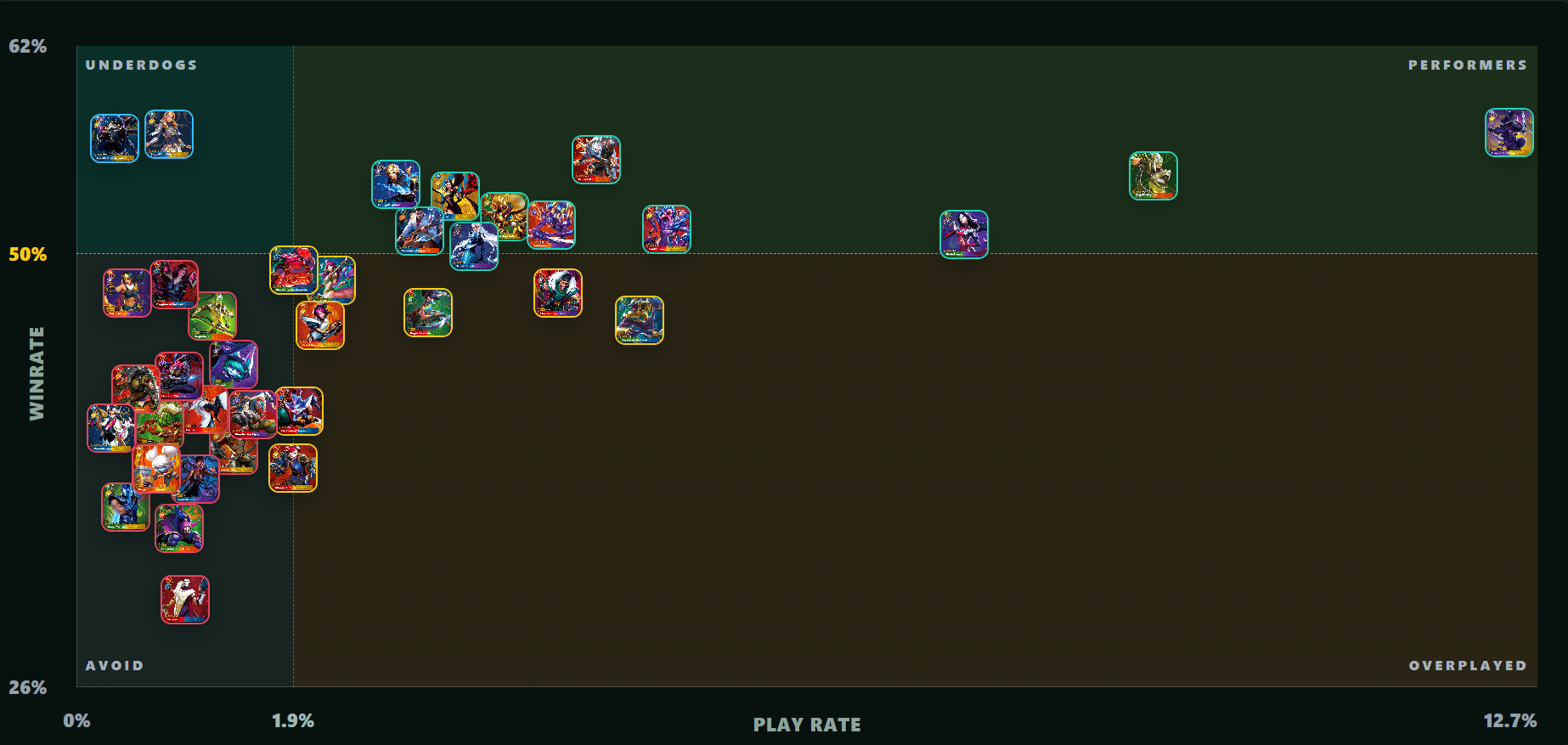
The strongest decks survived the target on their backs
One of the most important takeaways from Barcelona is that Kennen is the both the deck with the highest play rate and winrate which, I believe, is unprecedented.
That's particularly meaningful in a tournament like this.
Popular decks aren't catching anyone by surprise. Players know they will face them, build their lists with those matchups in mind, and spend a significant amount of their preparation testing against them.
Being the most performant deck while also being the deck being the most played is showing that's something is wrong with this deck.
Several underdogs deserve more attention
The upper-left part of the chart is also particularly interesting.
Viktor and Lux finished with well above-average win rates despite representing only a very small portion of the field.
These results should obviously be treated carefully because of the smaller sample sizes, but they are exactly the kind of decks worth monitoring going into the next tournaments.
A strong performance with low representation can mean two very different things: either the deck benefited from a favorable small sample, or the field simply hasn't adapted to it yet.
Barcelona gives us the first signal. The next events will tell us which explanation is correct.
Ornn defied all odds
Finally, Barcelona once again shows why looking at popularity alone can be misleading.
No one expected Ornn to be even in top 8 and it won the whole tournament. Ornn has an overall weak winrate but it had a favorable match up against Kennen (the most played deck) and this is why Ornn managed.
That's why the next step is to look beyond overall win rate and see which decks were actually able to convert those performances into deep tournament runs.
From Field to Top Cut: Who Actually Converted?
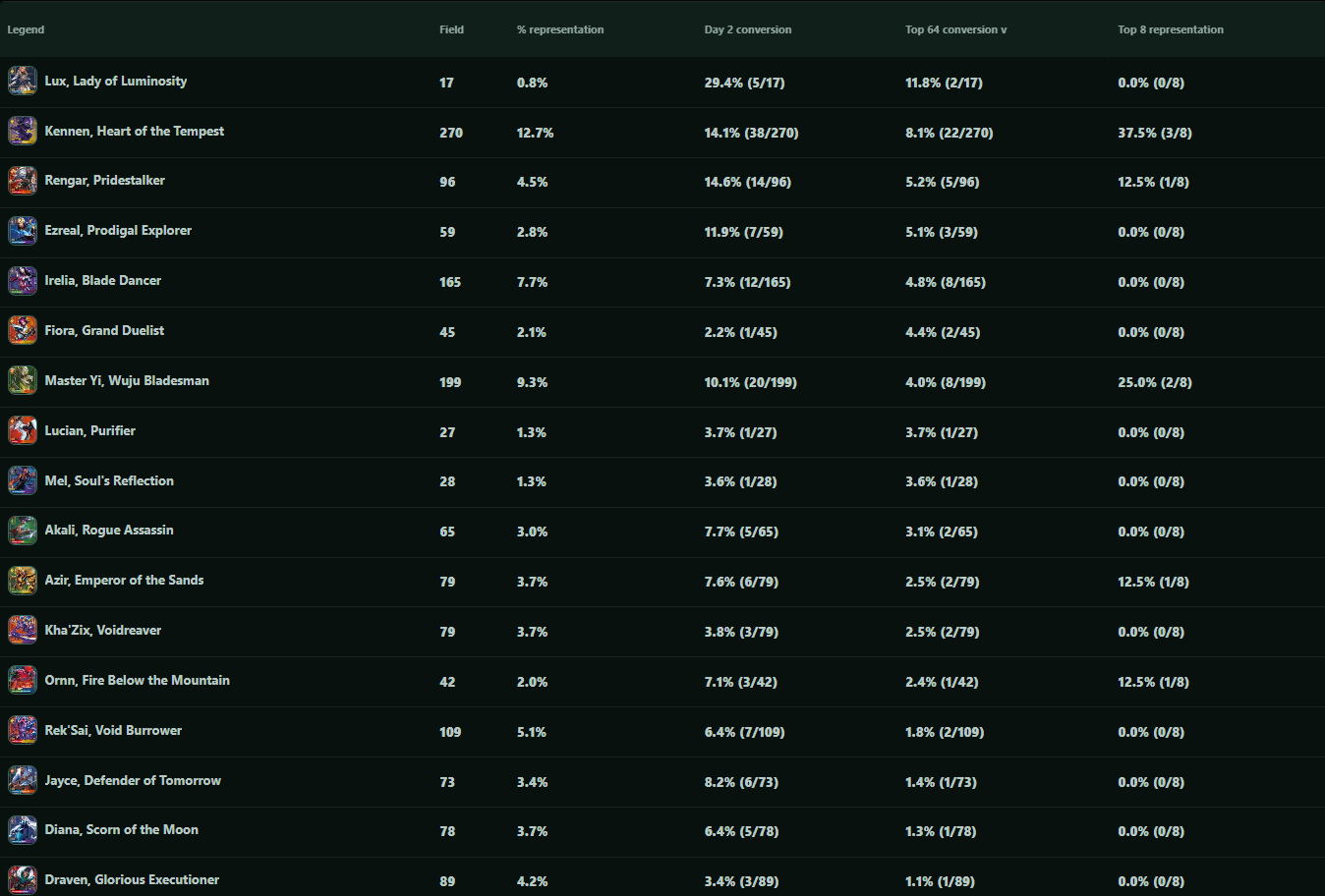
Lux is the legend that has the highest conversion rate, this matches her "underdog" spot. But her numbers are low, compared to Kennen who's the most played legend as well as the one that converts the most.
If you compare to Master Yi, who's the second most played legend, Kennen converts twice as much.
On the other hand, Reksai has been underperforming despise her popularity. More than a hundred players, only 7 to day 2 and only 2 to top 64.
Matchup Matrix
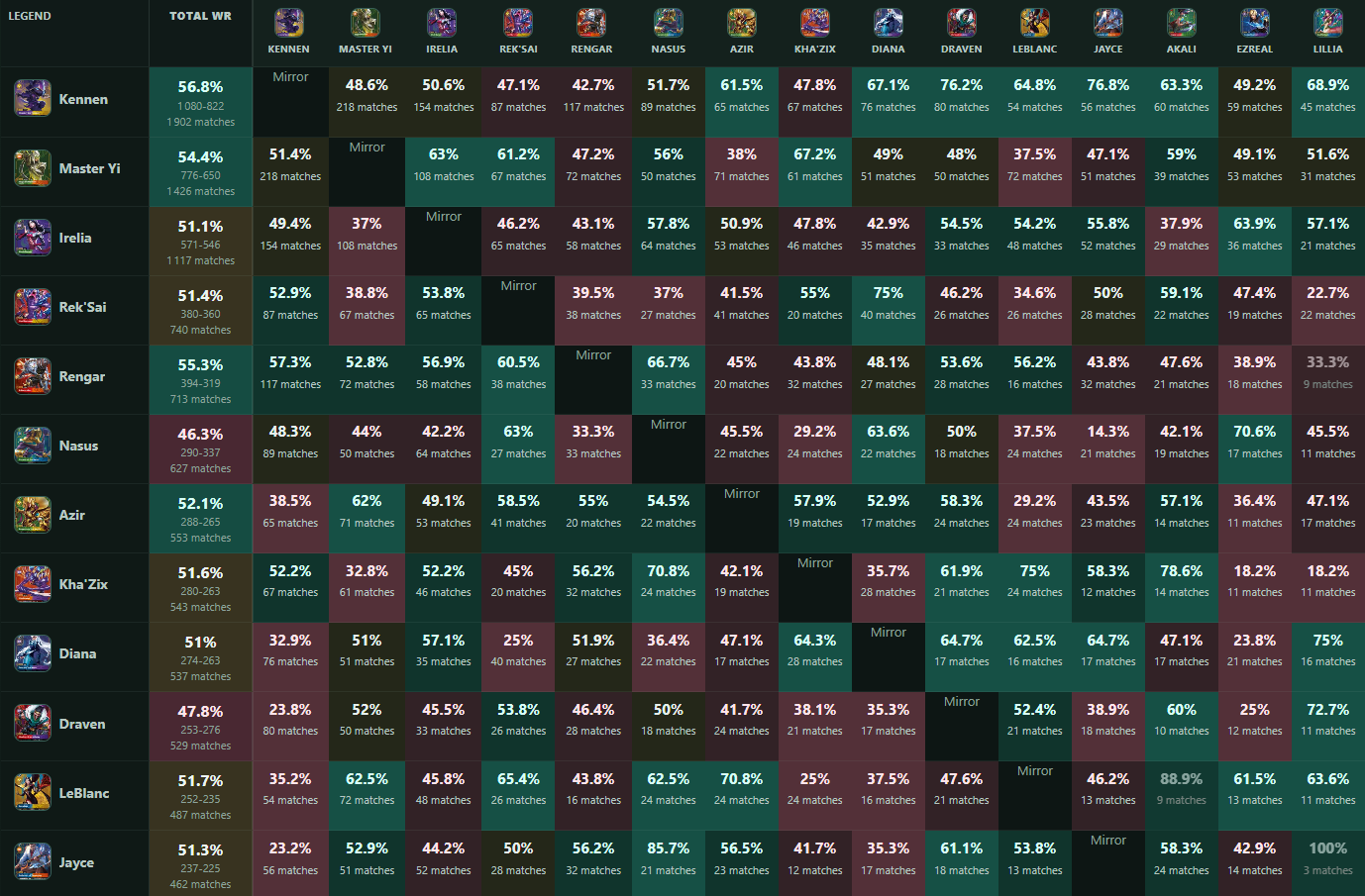
The Matchups Shaping the Barcelona Meta
Looking at overall win rates tells us which decks performed, but the matchup matrix helps explain why.
Barcelona was not a meta where one deck simply beat everything. Instead, most of the strongest Legends had very clear strengths and weaknesses, creating a fairly pronounced matchup cycle at the top of the field.
Kennen was the safest all-around performer
Kennen finished Barcelona with the highest win rate among the most represented decks at 56.8% across 1,902 matches, and his matchup spread explains why.
He performed extremely well into several relevant strategies:
- 76.2% vs Draven
- 68.9% vs Lillia
- 67.1% vs Diana
- 64.8% vs LeBlanc
- 63.3% vs Akali
- 61.5% vs Azir
More importantly, Kennen had relatively few disastrous matchups among the major decks.
His main weaknesses were Rengar (42.7%), Rek'Sai (47.1%) and Kha'Zix (47.8%), while the Master Yi and Irelia matchups remained close to even.
This made Kennen particularly well positioned for a large and diverse tournament: even when he wasn't favored, he rarely entered truly unplayable matchups.
Rengar had one of the strongest matchup profiles
Rengar's 55.3% overall win rate was not driven by one isolated matchup.
He was favored against several of the most important Legends in the tournament:
- 60.5% vs Rek'Sai
- 57.3% vs Kennen
- 56.9% vs Irelia
- 53.6% vs Draven
- 52.8% vs Master Yi
That is an extremely valuable profile when Kennen, Master Yi and Irelia are among the most represented decks in the room.
However, the matchup matrix also shows potential ways to attack Rengar. He struggled against Azir (45%), Kha'Zix (43.8%), Jayce (43.8%) and some of the less represented strategies.
Rengar therefore looks less universally dominant than Kennen, but potentially even more attractive when the expected field is concentrated around the most popular decks.
Master Yi had some extreme matchups
Master Yi finished at a strong 54.4% overall win rate, but his matchup spread was much more polarized.
Yi crushed several relevant decks:
- 67.2% vs Kha'Zix
- 63% vs Irelia
- 61.2% vs Rek'Sai
- 59% vs Akali
- 56% vs Nasus
At the same time, he had some very exploitable weaknesses:
- 38% vs Azir
- 37.5% vs LeBlanc
- 47.2% vs Rengar
This makes Yi's performance particularly dependent on the expected tournament field.
If Irelia and Rek'Sai remain popular, Yi looks excellent. But an increase in Azir or LeBlanc could make his position considerably less comfortable.
Azir could become an important meta answer
Azir's 52.1% overall win rate isn't as spectacular as Kennen or Rengar, but his matchup profile is extremely relevant.
Most importantly, Azir posted a 62% win rate against Master Yi, one of the strongest and most popular decks at Barcelona.
He was also favored into:
- 58.5% vs Rek'Sai
- 57.9% vs Kha'Zix
- 58.3% vs Draven
- 57.1% vs Akali
- 55% vs Rengar
The huge problem is Kennen: Azir won only 38.5% of their 65 matches.
This creates an interesting dynamic going forward. If players start targeting Master Yi and Rengar more heavily, Azir becomes increasingly attractive — but a Kennen-heavy field puts a very clear ceiling on the deck.
Rek'Sai's overall win rate hides an extremely polarized deck
Rek'Sai finished at 51.4%, but that number hides some of the most extreme matchup differences in the matrix.
The deck performed exceptionally well against:
- 75% vs Diana
- 59.1% vs Akali
- 55% vs Kha'Zix
- 53.8% vs Irelia
- 52.9% vs Kennen
But struggled badly against:
- 38.8% vs Master Yi
- 39.5% vs Rengar
- 41.5% vs Azir
- 37% vs Nasus
This makes Rek'Sai a good example of why overall win rate alone can be misleading.
A 51% deck can be extremely strong in the right tournament and extremely uncomfortable in the wrong one.
Nasus was one of Barcelona's clearest losers
Nasus finished with only a 46.3% win rate across 627 matches, and the matchup matrix makes the problem quite obvious.
He struggled against many relevant decks:
- 33.3% vs Rengar
- 42.2% vs Irelia
- 44% vs Master Yi
- 45.5% vs Azir
- 48.3% vs Kennen
There are some very good matchups — particularly 63% vs Rek'Sai, 63.6% vs Diana and 70.6% vs Ezreal — but they were not enough to compensate for poor results into several of the decks players were most likely to face.
Barcelona therefore looks less like simple variance for Nasus and more like a genuinely difficult meta position.
There is no single deck that beats the entire field
The most important takeaway from this matrix is the absence of a clean dominant strategy.
Kennen has the best overall numbers, but Rengar can beat Kennen.
Rengar performs well into many top decks, but Azir can punish Rengar.
Azir destroys Master Yi, but gets heavily punished by Kennen.
Master Yi crushes Irelia and Rek'Sai, while struggling badly into Azir.
That creates a real rock-paper-scissors dynamic at the top of the Barcelona meta.
Ornn Won Barcelona — But Ornn Did Not Win the Meta

The most surprising result of Barcelona is obviously Ornn winning the entire tournament.
In a field of roughly 2,200 players, winning the event is an incredible result and immediately puts the deck under the spotlight.
But when we look beyond the winning run, the overall data tells a very different story.
Ornn finished the tournament with only a 47.7% win rate across 264 matches.
And more importantly, several of its matchups against the most relevant decks in the field were extremely difficult:
- 35% vs Kennen — 40 matches
- 25.9% vs Master Yi — 27 matches
- 37.5% vs Irelia — 16 matches
- 35.7% vs Rengar — 14 matches
- 46.2% vs Azir — 13 matches
Those are particularly concerning numbers because Kennen, Master Yi, Irelia and Rengar were all major parts of the Barcelona metagame.
Ornn did have some favorable matchups, notably:
- 61.5% vs Rek'Sai
- 58.8% vs Nasus
- 69.2% vs Ezreal
But overall, this does not look like the matchup spread of a deck that dominated the tournament.
TheManLand's effect

When you look at Ornn's data, it looks horrendous. But not all of them played the same decklist. The player from Micelion practiced his decklist against the best players in the world and came up with something that no one plays that destroys Kennen. While the match up should have been negative for Ornn, he flipped it entirely with his cards such has Helm of Suppression and Pickpocket.
What's next ?
Looking at Ornn's decklist, it has some natural bad match ups. Master Yi is one of them: he can shut down both battlefields very fast in the early game preventing Ornn from gaining too much tempo. This could lead Yi to a better spot compared how it was during Barcelona.
But the real question is: can Kennen players adapt their decklist so they don't lose so hard to Ornn? If the answer is yes, then Ornn will suddenly be less appealing for the next major.